Monday, September 17, 2012

Buddha in the Sanitarium of Running Rats

Reading "Declaration of Insanity" by Khudair Miri in 2008 was an experience that aided me to put myself in a place. In a place for those psychiatrists who didn't concentrate well in what they are studying. In a place of those psychiatrists who prefer to sleep in the noon rather than reading Michel Foucault, for example.
My trials to read Foucault failed. There were no braises in my eyes when I was reading Foucault, but there was a yawning cow who had ate enough grass.

I got some friends who read philosophy with enthusiasm. I declared to them frankly, over and over again, that I don't understand philosophy, and I suspect that philosophy is dead.

It was before days when I was in central Baghdad. 


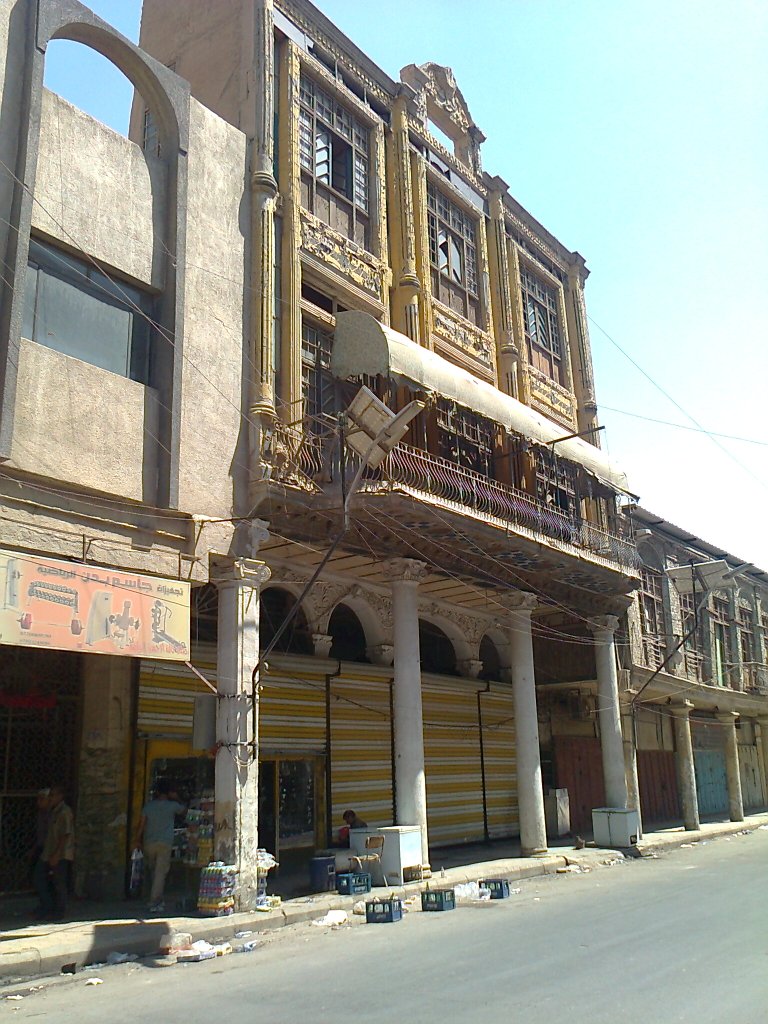
 The scene in front of the Ministry of Health is the same since 2008. They started digging in an Iraqi trial to make a complex bridge. They are stealing money. They are lying. They don't belong. Buildings from the 60s or 70s are watching the bitter scene.


 In my bag their were two books. One by Henri Avon entitled: Buddhism, and the other was by Khudai Miri entitled: "The Desert of Buddha".


 Khdair Miri, who wrote the "Declaration of Insanity" about his experience as an inpatint in Al-Rashad (Al- Shammayia" hospital, writes an imagined biography about Buddha while he was walking in the desert. In page 95 of the book which was published by "Al Hadara Publications" Buddha is taken to a place called "The Sanitarium of Running Rats".
 The two books added to me much. I knew about Buddhism and get more close to Khudair Miri's writings.  And from the windows of the second store of the red bus I took many pictures including this below that shows the mosque of Al-Khulafa to the left, and the church of the Latin to the right.
It was just another day of reading and walking in Baghdad.

Saturday, September 08, 2012

Artists of Existence


I know a little about Carl Justav Jung but I don't like him. All my irritations in front of those who are against any biological explanation of our mental life are projected on this Jung. I was not surprised to know about his unethical relationship with one of his patients that was documented dramatically in the movie "A Dangerous Method".
I was encouraged to buy that book written by D. T. Suzuki because its introduction was written by Erich Fromm, whom I respected since the very beginning.
After finishing Suzuki's book yesterday I find myself saying that it was Carl Gustav Jung who must had written the introduction and not Fromm. Suzuki talked about things like: metascience, antescience, cosmic unconscious, telepathy, the 6th sense and the rest of these eastern modes of thinking.
I live in the east and I know and "experience" how these melting non-structured concepts, when be taken for granted, be dangerous. Subjectivity Vs. Objectivity is not easily balanced only by a mature who had suffered enough seeking the truth. The eastern schools of philosophy or psychology can be easily taken by a lazy thinker and lit fires of evil. Goodness has masks, you know.
But I liked how Suzuki talked about the necessity of us being aware of our unconscious. But that didn't add a bit to what Freud had left us: these masterpieces, these writings that shine.
I liked Suzuki when he said in p. 54: "At the same time that we cannot wait to be all as scientists, nature had constructed us so as that we be artists… Not a spcial kind of artists like painters, or sculptors, or musicians, or poets, etc… but artists of life." I liked that. He continue saying that we can be artists by our behavior and by our production. I really like that. Our art is our production, our behavior, etc…
I liked that part of interview with Suzuki with Huston Smith when it goes like this:
Huston Smith (H. S.): you don't think that it's inevitable that man realizing that after 70, 80 years must die, is not necessary for him to think about his death and what happens thereafter?
D. T. Suzuki (S.): Exactly!
(H. S.): He doesn't have to?
(S.): No. 70, or 80, or 100 years that concerns "time". But when we are… Living itself is not in "Time."
(H. S.): It is not in "time?". The days come and go. There seem like time.
(S.): Yes, that's the way somebody thinks- somebody standing or imagining that somebody is outside time. But if we go on with time itself, there is no such question- "whether we survive?" or not. 

I now think that Erich Fromm had written the introduction to Suzuki's book because it is about existence. Existence and its arts.

Wednesday, September 05, 2012

Locus of Control Iraqia


For the first glance, it seems silly to discuss "The Art of Being" by Erich Fromm while living in Baghdad, Iraq. Almost daily we hear about somebody being killed by a gun and nothing more. The killers are always unknown.
Lack of security and of basic civilian services: electricity, good schooling, good medical care, etc… leaves us feeling entrapped in a narrow destiny.
Destiny?
Even the Iraqi who got an internal locus of control, according to Rotter's theory, will find his internal locus of control escaping like a frightened rabbit, or rat, when he would hear few bullets shots near him. His locus of control, his rabbit, or rat, is now external.
Freedom from the external restrains is difficult, if not fatal, in Iraq.
What is left for me to read in Fromm's book is that faint awareness of the necessity of freedom from internal restrains to be free from hatred, selfishness, and illusions, and to "Be" in love and compassion.
Another voice is telling me that it is the very best time that one should speak the truth and not respects power, titles, or fame. That it is time to declare that emperor is naked. Meanwhile, I will not listen very seriously to this second voice. I will just keep it in mind in my quotidian shallow affairs. I will only discuss such matters with friends whom I trust.  

Sunday, September 02, 2012

A Non-Trivial Walking in Baghdad

The last lines of Freud lecture were: "If you wish life, be prepared for death". I respect Freud. I imagine him talking with a bitter expression on his face. I liked how he was pictured in the film "A Dangerous Method". I respect what he says. The very bitter truth. But don't you think that this new training shoes are sweet:

"Well it's one for the money, and 2 for the shoes, and 3 to get ready and go cat go but don't you, step on my red train shoes". When my father, in the bitter poor 90s of the previous century, realized bitterly that his economy did not support anymore anything extra but some food, and essential clothes, I stopped my piano lessons. I wanted guitar. I was always good at school and when succeeded in good marks in the 4th secondary class he decided to buy me a guitar. The first tune was played with a single string: a song of Fairouz, and the family was happily surprized. The second was the song "Fast Car" by Tracy Chapman and the surprise became applauding. Then it was Elves Presley's "Blue Suede Shows".

"Fast Car" was my mother's favorite. I think she, like all of us, dreamed of leaving Iraq. 
One day I saw a caricature that I still don't believe in: an Iraqi who's roots are like a tree deep in the earth and showing: "We won't leave": 
Well, I think the truth is that , we all will leave if we have a respectful opportunity. Anyway. My friend, who's accompany is not trivial at all, offered me a walk in central Baghdad and we went walking fastely and taking photos and talking. He invited me to have lunch in a Kurdish restaurant: two sheesh of Kabab:
 Central old Baghdad is a very good place to walk in in Fridays. It is almost empty and very calm. And we walked. And we talked.

And I found a book by Erich Fromm entitled "The Art of Being". More modern than Freud but also bitter. He tried to write about the meaning of life, and the meaning of happiness and he wrote well but my concentration was not that intense in the reading and I was not taking notes postponing this to a second reading maybe till I reached the following lines: "The human being is like the Amazigh mythical hero Enti who charge himself from touching the earth who can only be killed by making him suspended in the air for a while"


 I remembered that Iraqi caricature of that man with his roots and shouting: "We won't leave!"
I remembered also Amin Maalouf's preferring  to use the word "origins" instead of "roots". I learned from Maalouf that we don't have roots, we have origins.
The talking with my friend was not trivial that day. My friend likes serious philosophical conversations and adds to me many insuring ideas, ideas that I suspected to be very subjective and non-speech-able but with my friend, Freud, and Erich Fromm, the existence is becoming clearer and less threatening, I hope.

Thursday, August 30, 2012

Sausage for the Cat

Since several months and I don't follow the Iraqi political affairs. I was surprised to read today in the journal that we still don't have a minister of defense (Army), nor a minister of internal affairs (Police). This is the case since two years. Our politicians don't trust each other.
I flipped the news paper to read an article by Sarmad Al-Taey which starts with the following lines: "The Middle East is not missing anything but more wars". The article talks about the Iraqi government reactions to the changes in our area. Such a gloomy article in the morning bus going to my first day of work since my summer vacation.

 By accident (accident?) I was carrying with me a collection of lectures by Sigmund Freud collected under the title of one of them: "Reflections on War and Death". Freud, at the first world war, started talking about THANATOS. About the second instinct we got. But the lines of his lecture were not so gloomy since I found phrases about how the citizen of the developed world can attend to "the graceful art of Beautifying life" and, "… the sense of law of order that had made man master of the earth". Freud ended the second part of the lecture by a phrase: "If you wish life, prepare for death."
After this frank brave lecture that I read thrice in a matter of two days I decided that I need some company. I went down to meet my neighbors. I knew that a brother of one of our neighbors was killed by four bullets in the neck before yesterday. We went together to our neighbors' house and gave him our condolence.

 We went back and sat together near our houses. After some silence Shoushou approached. She wanted E. to get her her dinner. E. went up to his apartment and he was sorry that all he got was frozen sausages. I commented: "she will like it, it will be like an ice-cream for her".
We chatted and laughed.
 When I went up I saw the supplement of today's journal (al Mada journal, my favorite), which shows a Swedish poet that merely heard his name before and never read a poem of his. I tried to read one but I didn't find it good. What I liked about the picture is that he got a stroke that affected his right hand but he still plays piano with the left.
   

Monday, August 06, 2012

The History, with a small "h"


"The History, with a big 'H', is of course that of nations, of eras and big movements of the humanity. With a small 'h', it becomes this history of human beings, of small groups, of families, etc." Ameziane Ferhani, in the Editorial of the supplementary #4 of El Watan newspaper that was published the last month on the 50th anniversary of the Algerian independence from France.  


The Centre Culturel Francais, Baghdad 1999
----------------------------------------------
I approached him:
- You are Algerian?
- Yes. He answered with surprise.
- Then give me a kiss.
- Ha ha haa...

Just few minutes with him was enough to know that he is sensitive to the tiniest alluring to any special relation, what so ever, between Algeria and France. Days after our first meeting we were walking in Al-Mansoor district of Baghdad when he said with marked bitterness: "I hate the racists". I stayed silent. I didn't notice the sign of racism that he thought he noticed in the face of that French young man. He murmured with a bitter husky voice that looked like a whisper: "Dirty.... Rats".

He sensed my neutrality (neurtality?) so he took a deep breath and told me this story as an evidence of how easily a European can be turned, in a blink of an eye, to a racist. He said:
"Once I saw two Europeans in Algeria. They saw a shoe-shiner-boy. One of them put his foot on the box of the boy who started to shine his shoe for him and the other took photo for the scene. How sarcastic their smiles were!"

My Algerian friend had left Iraq after months later and we didn't met nor contacted each other since then. Of course shoe shining is not a shameful job, according to my attitudes, and there are many shoe-shiners in almost every big district in Iraq, but since 1999, I could not feel at ease while seeing them.


 Algeria, Bou Saada, 7th of July 2012
--------------------------------------
An article in El Watan about the shoe-shiners in Algeria in the colonial era. The writer, Amezian Ferhani narrates his memories with the shoe-shiner-boys in Alger, the capital. His father used to take him to drink sore gaseous juice of pomegranate and to ride a donkey sometimes. Amezian Farhani was a child who was attending school. He saw that those shoe-shiners are not very clean and that the clients let the coin fell down in the tiny hand of the shoe-shiner without touching it. Amezian Ferhani, the child, noticed that they disappeared from Alger after the independence. His father explained: "They set fire in their wooden boxes and joined the school". Amezian Ferhani felt so happy. 

 Amezian Ferhani narrates beautifully. He studied the case of the disappearance of those shoe-shiners and found that, after the independence, a play named "Des roses blanches pour ma mere" was played at a theater in Algeria and it was about a shoe-shiner who was seeking medications for his sick mother. The play was very emotional and the president Ben Bella was attending the show. Ben Bella had walked up to stand next to the actors, at the end of the play, and declared the end of the phenomenon of the shoe-shiner-boys in Algeria.
Amezian Ferhani also mentions that song by Maurice Chevalier which is talking about those shoe-shiner-boys. It has some ridicule in it. (Some racism?). (Did he said BANANAS in the lyrics?). Anyway.


6th August 2012
Bou-Saada, Algeria
05:16 PM
------------- 
I am guarding my fasting. I mean I am practicing my fasting with my family. I am relaxing most of the time. El Watan is such a wonderful journal. I used to keep articles that appealed to me. I searched my archive of 2011 and found other articles by Ferhani. I will try to spend the time remaining for my fasting reading his articulate elegant narration. 


Saturday, August 04, 2012

Sigmund Fellag

In page 49 Wanda reaches Paris coming from Sarajevo. Wanda fall in the ground of the train-station and her bag is opened and the air is taking her books, papers, clothes, and a photo album, among other things, away. Farid, the French of Algerian origins, had never seen such beautiful and sad green eyes. He run to help her.
In page 175 Wanda and Farid are sleeping together in the same bed with a baby named: Ladmilla-Samira-Francoise. Page 175 ends with the following lines:
“Thousands of swans fly carrying him on their back to put him in the arms of Morpheus. Just before the god of dreams, the son of the Night and sleep, has closed the door of his kingdom, Wanda turned and asked with a husky voice:
- Love…
- Yes, my love…, Farid could articulate those words
- Do I love you enough?
- You love me like a crazy”.

I dreamt before few days that I was flying. Such a repetitive common dream. A happy one indeed. In my dream I was flying in a high altitude above Bou Saada. I landed just outside Bou Saada in one of the mountains that is surrounding it. Bou Saada was encircled by a barbed wire fence.   Ann old came from behind me and he started a friendly conversation with me. Men started to gather. We were all outside the fence. When we become about 10 in number, all men as I suppose, the old man went near the fence and found a rusty iron rectangular sheet of metal and held it up in a difficult move. We started going in. I headed to a primary school and directly to its library. All the books were uninteresting for me. The librarian was interesting. She was a beautiful serious woman. I saw a thick book and hesitated about borrowing it but finally I decided that I have many books to read and this is a thick one, and it was about history. I woke up.


“Rue des petites duarades” is a novel by Fellag. It is about an imaginary neighbourhood where Farid, Wands, Sergui, Akli, Andre, Mourad, George, Mr. X, and many many others live. Some were always here and few of them are racist. Some had come sometime to this place and stayed in it. You can find the Moroccan, the Algerian, the Serbian, the Ukrainian, and so. The type of food and the type of music mix with each other. A funny novel indeed. Thank you Fellag.


Freud doesn’t mention great thing about flying dreams in “The Interpretation of Dreams”. He twice (p 165-66 and p 255-56) repeats the same paragraph word by word. He declares that he himself didn’t dream such a dream. He thinks that it is linked to the childhood games when somebody older than us (an uncle for example) was holding us high and makes us move like we are flying. So the dream is just a souvenir of that happy moment when we were a child. He mentioned that there is a scientist had linked it to erection. An alluring link to erotism is also present. To add a Freudian flavor.
Freud says something good at the beginning after all. He said that even if we regard the flying dream as a “common” dream. But this does not mean that it cannot be “personal” or “subjective” or “special” I forgot the exact word.
In my case, in my dream, I would put the following explanation:
I am happy that I am going visit my parents, with whom I shared a happy childhood. Flying in my dream can concretely linked to the way I saw Alger the capital approaching the window of the airplane of Eygptair I was inside, or can linked, more complexly, to when my parents were holding me up into their arms and sometimes make me feel like I am flying.
Bou Saada and its fence, and the ten men? I would say it means the difficulties of traveling from one country to another, the police and their way of treating people, the non-respect of individuals, the absence of smile from the faces, the grimace, the tone of the voice, etc..
The rusty door didn’t open to me only because I am an individual. We gathered. We waited till we become about ten, then we proceed. We respect the rusty door too much. Our society give importance to groups, not to individuals.
The library? Why do I love books this strongly? What is the emotion that is sublimated strongly? And finally the librarian, the beautiful librarian. Well, I don’t know.
Anyway, I don’t regret the time I spent reading and translating Fellag nor seeking and the advice of uncle Freud, (uncle?). I had great time and I had learned many things.

Monday, July 30, 2012

History of a Land, from a subjective point of view

The protagonist in Rachid Boudjedra’s novel “Le Démantèlement, Denoël, 1982” was an ex-communist and participated in the war of independence of Algeria. He was having a disease and a young female used to pass by his lodgment to just offer the little help that she can to this old lonely man. He started to talk to her about his memories of the war. She asked him questions about the color of the eyes of his compatriots. About the way they walk, eat, and talk. She showed less interest in what the old man regarded as “history”. She wanted to see the history of her Algeria from another point of view, a subjective point of view.
 
 I reached Algeria in the 4th of July. I reached home when I met my family and we talked till late at night. When I woke up the next morning I went walking to buy El-Watan, my preferred journal and they gave me with it a free supplement. It is the 5th of July, the 50th anniversary of the Independence Day of Algeria. I liked the most the photo of the old lady in the cover since it tells much to me. Blame my lethargy or my poor French language abilities, I didn’t read the supplements, but I gathered them, day by day, and contemplated the photos.
I preferred to re-read Tahar Djaout’s “Les Cheurcheurs D’Os” since I got it in French and in its translation to Arabic by Jilaly Khallas so that I can compare the two texts and enjoy learning French and Arabic in a comparative way.


The protagonist of Djaout’s novel is 14 year of old. Never left his small village before. The novel starts at the day on independence when the people are still celebrating. At the same time they decided that they should bring back the bodies of their sons, the martyrs, who joined the mountains and held the arms against the French army. The unnamed protagonist had an older brother who had joined the mountains and never came back since about two years. The parents asked our 14 years old protagonist to go, like the others, and bring back the bones of the martyrs of their relatives.
Our protagonist was not convinced of the validity of the idea. They chose an older relative of him named Rabah to accompany him. A neighbor offered one of his donkeys to help them in their travel. The travel lasted days. Most of the time they were silent. The novel tells about the protagonist’s remembering his memories with his friend in the old days while he was silently accompanying Rabah, not convinced of the mission given to him.
He discovers the villages around their area and few cities. He drinks gaseous juices for the first time in his life. And saw people with clean clothes and many cars and he felt ashamed of his own clothes and of their accompanying donkey. 
They finally met someone who seemed to know the place where his old brother was buried. He took them to the place and they started digging. The first skeleton found was having a golden tooth. They reburied that skeleton and went to another place and started digging and the second skeleton was of an animal, might be a dog.
Our protagonist’s bitterness and sarcasm reached a peak that he agreed that they continue and he accepted to take the third skeleton in his bag and the journey of return to the village was tasteless and absurd. Our protagonist reached a conclusion that that only living being in his village that now he is re-entering is the donkey that accompanied them.

I think the novel was not translated to English since I failed to find any hint in the internet about how to write its title in English.
I started a second novel and that was of Mouloud Ferraou, entitled “La Terre et le Sang” since I have it in both languages: French and Arab. I was surprised to find that it was translated to English by Patricia Geesy and entitled: "Land and Blood”

Days later I started another search about “Les Chercheurs D’Os” and I found an article in English that I can read freely via the net and it was written by the same person who translated Mouloud Ferroun’s “Le Terre et le Sang”, Patricia Geesy. I would choose the following line from the article that I liked a lot:

“ His (Tahar Djaout) writings does not present a narrative transcription of the factual history. It seeks rather, to establish intertextual link with other discourses of history, conscious of the fact that, as Roland Barthes has noted, historical discourse cannot follow or create reality itself, it can only “present itself as a sign of a dead thing”.

The link of the article:
 
http://www.jstor.org/discover/10.2307/396721?uid=3737904&uid=2129&uid=2&uid=70&uid=4&sid=21100951533313