Monday, July 30, 2012

History of a Land, from a subjective point of view

The protagonist in Rachid Boudjedra’s novel “Le Démantèlement, Denoël, 1982” was an ex-communist and participated in the war of independence of Algeria. He was having a disease and a young female used to pass by his lodgment to just offer the little help that she can to this old lonely man. He started to talk to her about his memories of the war. She asked him questions about the color of the eyes of his compatriots. About the way they walk, eat, and talk. She showed less interest in what the old man regarded as “history”. She wanted to see the history of her Algeria from another point of view, a subjective point of view.
 
 I reached Algeria in the 4th of July. I reached home when I met my family and we talked till late at night. When I woke up the next morning I went walking to buy El-Watan, my preferred journal and they gave me with it a free supplement. It is the 5th of July, the 50th anniversary of the Independence Day of Algeria. I liked the most the photo of the old lady in the cover since it tells much to me. Blame my lethargy or my poor French language abilities, I didn’t read the supplements, but I gathered them, day by day, and contemplated the photos.
I preferred to re-read Tahar Djaout’s “Les Cheurcheurs D’Os” since I got it in French and in its translation to Arabic by Jilaly Khallas so that I can compare the two texts and enjoy learning French and Arabic in a comparative way.


The protagonist of Djaout’s novel is 14 year of old. Never left his small village before. The novel starts at the day on independence when the people are still celebrating. At the same time they decided that they should bring back the bodies of their sons, the martyrs, who joined the mountains and held the arms against the French army. The unnamed protagonist had an older brother who had joined the mountains and never came back since about two years. The parents asked our 14 years old protagonist to go, like the others, and bring back the bones of the martyrs of their relatives.
Our protagonist was not convinced of the validity of the idea. They chose an older relative of him named Rabah to accompany him. A neighbor offered one of his donkeys to help them in their travel. The travel lasted days. Most of the time they were silent. The novel tells about the protagonist’s remembering his memories with his friend in the old days while he was silently accompanying Rabah, not convinced of the mission given to him.
He discovers the villages around their area and few cities. He drinks gaseous juices for the first time in his life. And saw people with clean clothes and many cars and he felt ashamed of his own clothes and of their accompanying donkey. 
They finally met someone who seemed to know the place where his old brother was buried. He took them to the place and they started digging. The first skeleton found was having a golden tooth. They reburied that skeleton and went to another place and started digging and the second skeleton was of an animal, might be a dog.
Our protagonist’s bitterness and sarcasm reached a peak that he agreed that they continue and he accepted to take the third skeleton in his bag and the journey of return to the village was tasteless and absurd. Our protagonist reached a conclusion that that only living being in his village that now he is re-entering is the donkey that accompanied them.

I think the novel was not translated to English since I failed to find any hint in the internet about how to write its title in English.
I started a second novel and that was of Mouloud Ferraou, entitled “La Terre et le Sang” since I have it in both languages: French and Arab. I was surprised to find that it was translated to English by Patricia Geesy and entitled: "Land and Blood”

Days later I started another search about “Les Chercheurs D’Os” and I found an article in English that I can read freely via the net and it was written by the same person who translated Mouloud Ferroun’s “Le Terre et le Sang”, Patricia Geesy. I would choose the following line from the article that I liked a lot:

“ His (Tahar Djaout) writings does not present a narrative transcription of the factual history. It seeks rather, to establish intertextual link with other discourses of history, conscious of the fact that, as Roland Barthes has noted, historical discourse cannot follow or create reality itself, it can only “present itself as a sign of a dead thing”.

The link of the article:
 
http://www.jstor.org/discover/10.2307/396721?uid=3737904&uid=2129&uid=2&uid=70&uid=4&sid=21100951533313


The Maturity of Le Petit Prince


“The poeticallity of age is in the sustainability of surprising” Mahmood Abdul-Wahab


How can we define “being mature”? The answer is easier if we are talking about a fruit, a pear for example. But even for a pear, if we let the human judge its maturity, then the judgment will vary relatively from one person to another. Me, myself, was a witness of an argument between two old men about the question: when a banana can be regarded mature enough to be eaten?

And come and apply this question to human beings themselves. When we are mature and what is maturity. If we try to digitalize the problem then we will find some results: most of the world regard as 18 as the years enough to make a human being mature.

In the old times sexual maturity was the mark of being a mature man or woman. In the old times, when we needed less years of education to graduate to the society and hold a job (farming for example), we will be economically and sexually mature at the same time. Some pretend that societies were very immature that when people reach the age of 13 or so, they are not only economically and sexually mature, but also socially mature.

What is the age of “Le Petit Prince” that Antoine Saint Exupéry had met once when the engines of his airplane syncoped over the immense reality of the desert? 

The pilot was alone in the face of the desert when the “petit” prince came posing his questions. When the pilot’s faked maturity was exposed to the questions of the “petit” prince, he remembered his childhood and his drawings. The pilot returned to the child inside of him and wrote us a masterpiece that will be read and re-read again and again over centuries.

Sunday, July 29, 2012

Highway 13

Its 03:01 AM in Algeria time and the muezzin will call for the start of fasting in an hour. I noticed that I didn't wrote in my blog since about a month. I wanted something to stimulate an issue to write about. I decided to start by putting my photo in the Roman Theater in Jordan/Ammar taken about three weeks from now when I was waiting for the airplane to take me to Algeria to spend some days with my parents and sisters.  

In Jordan I used to spent the day reading the daily journals and watching T.V.

Songs used to stimulate me to write something good and since I got nothing specific to say I tried to listen to radiohead but the song was frightening. So I typed "John Lee Hooker" in the youtube search bar and chose a song I never heard before named "Highway 13". I like the title. I like 13. It is an old friend of mine.

But the song is so boring. I am trying now to hear something better. So that I can at least, something, that is not boring. Eric Clapton and B.B.King: Crossroad 2010 live:


A good start my heart. So let the rambling begin:

If one day I should have a hallucination
O God
Let it be guitar blues
Or a saxophone solo from
New Orleans

If one day I should die my God
Recreate me as a tiny hair
In the hands of a berber grandmother
So that I can smell all the dishes
That she makes

Why the hell I am bitter. Sami, let your wish be more joyful please. Okay camarade, here is it:

How it is cool to be a string
In a maroon guitar
Waking up when the tiny pick
Tickle me and I giggle a blues tune
A tune of dementia and delirium of the early morning

I would smell the mixture
Of the musicians' cigarettes
Will fall in love with a tiny bird from Nicaragua
Colored as a Chinese toy
Or a berber woman dress

Silly? It is 03:27 AM still and I want to write something silly at last in this blog that seriousness had made it gloomy as a black lace tissue in front the face of a cold thin white widow standing in front of her deceased husband who liked to collect jars from Africa. When she went back home she gave all the jars to the mental retardation institution next to her house and when she came back home and before sleep she found another jar, half broken, at the corner of the room and muttered the word "shit" as she was finally putting her head on the pillow. The last Gauloises had lest a taste in her mouth that she now tastes with some satisfaction. She even smiled to herself as she turned to her side and closed her eyes after taking in a fast deep breath releasing it slowly and calmly. Finely alone.

It is 03:33 AM and I think I should put an ending to this rambling. What to say?
I don't feel I am ready for marriage but my parents had opened the issue with me. What to do? I didn't find her. I dreamed about her once. She run away when I wake up in the dream and I wanted to see her face so I chased her in the corridor of our house. She opened the door and tried to shut it. I tried to open it but she was on the other side closing it. I knew that she was smiling. Then there was a well bellow a huge tree in front a church. The skies were gray (about to rain?). Her hand came in a slow motion from behind my face. My movements were also in slow motion. I didn't deliberate that. It was like the time was elongated. Her hand was carrying water to my mouth. I drank. It was cold heavenly water. She slipped away. I didn't see her face.

It is 03:41 AM and I think I should stop to go to drink a cup of coffee with a croissant and fume a cigarette or two from my Gauloises (Blue) waiting for the muezzin to call for the prayer so that I finally..... sleep.

Will leave the title as "Highway 13" since I got some fidelity to those who inspired me the first, and an ambiguous relation with number 13 


Monday, June 25, 2012

Dictatorship from a Cherry Point of View


I am hearing now Tchaikovsky Symphony No. 6. I want to write about that novel, Herztier. Herztier, as it is entitled originally in German, "The Land of Green Plums" as it is entitled in its English version. Its Arabic version is entitled: "The Animal of the Heart". Herta Muller said that the novel was written "in memory of my Romanian friends who were killed under Ceaucescu regime."
"And when all are asleep, the winds sleep in the trees." P.42


I took the Arabic version with me to my worksite and I had no white empty paper to write the notes but the last edition of "Tatoo", a monthly Iraqi newspaper specialized in art.
Before I went to the room that I share with two other companions I bought cherry. I didn't know that the word cherry will repeat itself so much in the novel. I might have a faint unconscious allure to a link to the word: "plum". I even had called Herta once, in a day dream: "my plum".
"Dead people don't need the barber, don't need to cut their nails, and don't lose buttons." P15


Cutting the hair is a repetitive happening in the novel. Losing bottoms too. As if the protagonists as astonished that their bodies are still, having some kind of life, in it. In page 164 of the Arabic edition the writer wrote: "It would be nice if love grows like grass."
The protagonist is the only unnamed person in the novel. We know early in the novel that she is a female. Her father was a soldier in SS. He is proud of his history. After the suicide of a student, the protagonist found three men (Edgar, Kurt, and George) interested to know more about what happened. They had a secret place where they hide books. They write poetry. The protagonist started to spend time with them. All the four were eager to leave Romania. The protagonist did leave Romania to Germany in page 160 in the Arabic edition. She kept writing about her memory. The most memory that was stuck in my mind was how the Chief Bele asked her to took her clothes off and then to sing a national anthem. 


The protagonist wrote about her memory of the days that comes after the suicide of Lola when they were clapping the hands after the head of the school told them that Lola's deed was a shame and that she would be not regarded anymore worthy to be as a part of the communist party. The clapping started to wane after few seconds but few students kept applauding. Those who stopped thought that they should start again clapping so that the sound will rise again and that what did happen.


I remembered when I was reading those lines how we, as students in school, were under the obligation of clapping our hands furiously every time the name of Saddam Hussein is mentioned. I remembered Nasif Falaq novel "Khidr-Qad and the Olive-colored Era".   

I am still hearing Tchaikovsky Symphony No. 6 and it is getting little… a little noisy.
I will keep the volume high while just mentioning that long Iranian film named "Taste of Cherry". The protagonist was trying to find somebody helping him in his suicide. He found that old man at last who he, himself, had tried to suicide before. The old man told him the story and how it was hard to tie a robe on a tree so he decided to climb it and when he was there, in the tree, trying to tie the robe so that he can suicide, his hand catched, by accident a cherry. 


He ate one. Then two. Then three. Then children came and asked him to shake the tree for them. And that was enough for him to quit his plan. When his wife woke up that morning she was surprised with a dish full of cherries.
These are the kind of stories that you can expect from area like, Iraq, Iran, and Romania.   
It was 20 minutes since I have started hearing Tchaikovsky's symphony no. 6, and now the second part had started. It is an allegro. One of the most beautiful melodies that I have ever heard. 

Wednesday, June 13, 2012

The Spellbound's Inferiority


I have translated the title of the novel in a previous post as "The Passion Bearer" but while contemplating the edition I found that Al-Mada publication Company had already translated the title to "The Spellbound".


 His souvenirs from the last war were multiple small shells of a military-airplane bomb resting inside his skull that left him with frightening auditory hallucinations. That was enough for his family (mother, brother Ismail, and sister Zainab) to isolate him more than before, he, the lover of books, the detester of violence, who was called sarcastically by his brother Ismail as: Gandhi. His mother fells disgusted when find him close to his sister talking about literature. He used to talk to his sister about the books he read and advice her about reading them. His mother allured that she thinks he is a homosexual when one day she found him talking to his sister Zainab.

The protagonist is unnamed in the novel. His only friend, the psychiatrist, whose father had suicide, carries the name: Nadir Salih, an Arabic name that can be literally translated to English into: "Rare Good".

 Our protagonist is not only unnamed but his small family had bribed a lawyer and edited a death-certificate for him, so that they can take his few meters of land, left to him by his dead father, in the south of Iraq.
His friend, the psychiatrist, failed to offer him, and his auditory hallucinations, but a crazy night of binge drinking of alcohol with the strange sexually-provocative disinhibited wife of the psychiatrist who is named Niran (can be translated literally into: "Fires"), and a reckless car driving that ended in a fatal car accident.
After that accident the last chapter started and it is written by the protagonist's sister, Zainab. The chapter is actually a letter written to our protagonist reminding him, thankfully, of the time that he spent with her (his sister) and his advices. She mentions, for example, that day when he advised her to read "Les Yeux D'Elsa" by Aragon, who wrote this poem to his wife, and Zainab mentions her difficult life with her brute husband, the smuggler. She seemed to regret her marriage to that smuggler who played the role of the manhood in the eyes of her mother and brother Ismail against our protagonist's peace-loving "femininity". Zainab tells about her longing to her brother and she questions if he still.. exists!
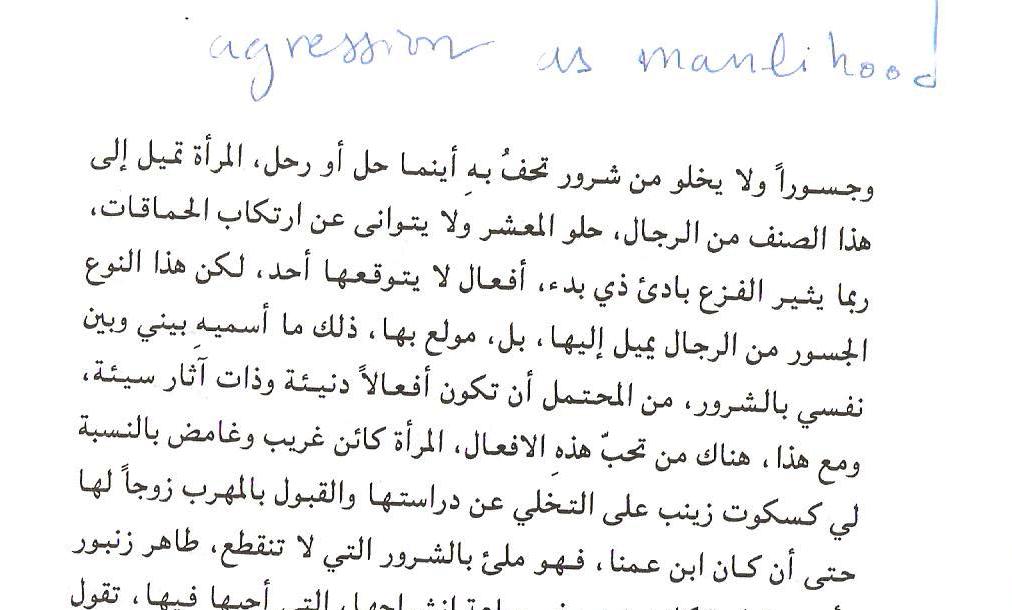
 It is a novel about the struggle of the peace-lover, art-lover, humanistic person, in an ignorant brute society where manhood is equalized with aggression and savagery. Politeness and calmness would be seen as cowardice, and any male who would not be a beast would be regarded as a homosexual, even by his brother, or more strangely, his mother, while the father, as in another novel by Ahmed Khalaf, is absent, or dead, or even… committed suicide.

Author: Ahmad Khalaf
Title: The Spellbound
Al-Mada P.C.
First Edition: 2005
Copyright to Al- Mada


Sunday, May 20, 2012

Literature, Fathers, Psychiatry, and Me

When I graduated from secondary school I proposed to my parents the college of literature as my career. My father told me that I can read literature whenever I like, and I may even practice it, while being a doctor.
In the first three years in the medical college I was among those with the highest marks. When my father left for the UAE, my marks, along with my mother's health, started to deteriorate.  
My father came back to find me interested in psychiatry, and our rapport with each other was already, pale.
 It was in Al-Hilla where I was trying to make a family of friends and I succeeded, hence, I adore Al-Hilla.
"The Death of the Father" is a novel of Ahmed Khalaf published in Baghdad by "The House of the Cultural Affairs" in 2002. In its cover there is a painting by a painter named: Salma Al-Allaq, which might symbolize Baghdad, the city that Amjad, the protagonist, adores. Amjad's father had been killed in an unclear circumstances while he was in a visit to his village of origin. Amjad was "the son who was forced to be a father" while he was only 19. He now works in a newspaper. He started also selling books in Al-Mutanabbee Street. He told us about his lost of that book entitled "The Treasure" who worth a fortune. 
 He told us about his friend's loss of his brother, Ismail. His friend also had lost his mother after his parents were divorced. His mother married his paternal uncle Noah. The story tells about a psychological instability of the father of Amjad's friend. The novel even allures to the ending of the father in a mental hospital.
Hussein Sarkam Hassan, an Iraqi doctor who is interested in literature, had written a book about Ahmad Khalaf novels. Dr. Sarmak start with the note that Ahmad Khalaf had written an article about Paolo Coelo's novel "Alchemist" which tells about the searching of a treasure, which finally appears to be in the homeland of the researcher. 
 Dr. Sarmak starts to give evidences of the recurrence of the theme of "Absenteeism" in Khalaf stories, especially "The Death of the Father". Dr. Sarmak had even entitled his book about Khalf: "The Bloody Comedy of Absenteeism: a study in the stories and novels of the Iraqi creative Ahmad Khalaf".
Amjad, in the novel, had an absent father, a lost book, and poverty. His friend got a lost mother, brother named Ismail, a paternal-uncle named Noah whom he liked and preferred to his father. 
 I didn't finish nor the novel, nor the critic about it, but I could not help not buying a newer novel by Ahmed Khalaf, entitled: "The Passion Bearer". I could not but surprise happily when read in its first chapter about the aloofness and strangeness of the protagonist, and about his memories of his lost brother: Ismail. And you know what? In the second chapter, the protagonist, who still unnamed to me, had read, while walking the streets, a name of one of his old friends in the secondary school, in a window of a private clinic of a psychiatrist. His friend had become a psychiatrist. He decided to pay him a visit in his private clinic. Not only for the memories for their comradeship, but for other reasons.

Three books rests over my laptop with Herta Muller offering a cigarette in the desktop, and Patrick Suskind' Pigeon is giving me.... an eye. 

Monday, April 30, 2012

About Boundaries & Mines

Trista Pena. I am hearing now "Trista Pena" by Gipsy Kings.
And it is Sherko Fattah that I was reading those last days. A novel about a Kurdish smuggler living on the borders between Iraq and Turkey and Iran. He is much respected and valued for the risk he is taking on walking across those borders filled with mines.
His family quickly got the habit of not asking him about the mines. It seems that there was a non-spoken agreement stating that mentioning the mines might bring bad luck, a kind of a curse.
 The story is about that smuggler's strive for survival after 1991 war and the start of Kurdistan separation from Iraq and all the problems that paralleled. He lost his son and he is not sure what happed. He suspects that his son had joint an Islamic militia. The smuggler's sister lives across the border. It is not totally clear at the beginning of the novel but as you pass page 200 you start to figure out that the smuggler's house which joins him with his wife and his now "lost" son, is in Iraq, while his sister is living with her husband few kilometers away, inside Turkey. The smuggler's problems are doubled symmetrically across the borders. His troubles are multiplied by a factor named post-1991 chaos.
But let us go back a little to another border, to another conflict. The Freud Vs Jung conflict and read from Jung's autobiography one of his dreams:  
"..on one of the mountainous areas at the Swiss-Austrian borders, and near the evening time, I saw an old man wearing the uniform of the Austrian customhouse. He walked by my side. He was bent and he never looked at me. His facial expressions were closer to obstinacy, sadness, and annoyance. There were other people in the scene. One of them had told me that the old man is not really here, but it is his spirit, the spirit of the customhouse man who died since years, (he is one of those who cannot die like how it should be)… this is the first part of the dream".
Yesterday I was in Al Mutanabbee street and I liked to walk in the backstreets.


In the backstreets of it and found by accident a used book entitled: "Freud or Jung" written by Edward Glover. What is interesting is the signature of the original owner of the book: "Rose Khaddourri, NY, 1961" and Rose Khaddourri is one of the Iraqi Jewess and a pioneer in teaching method and school opening. As any other Iraqi Jew, she was forced to leave Iraq in the middle of the 20th century.
 

From the book I knew that Cyril Connolly had once wrote a letter to Edward Glover telling him: "I feel the Jung's reputation has grown out of proportion. [….]. His work is a distortion of Freud's ideas by the injection into them of unscientific mystical feelings which make them popular. In the work of Jung there are elements in which Jung's own desire for a religious, rather than a scientific, conception exists."
I am still hearing Trista Pena by the Gypsy Kings.
Let us go back to Sheko Fattah novel and read:
"Why I am not allowed to know a thing about my son?
Bino was surprised for a while. Then he shook his head with a stronger intensity.
-          Because it was a long time since he was lost. You are digging in the past. Don't you understand that there is no past here, at least for those people like you. The past and the future do not exist for you. For you it is only the present that exists and anything else is a taboo. That must be clear to you anyhow."
p. 212


 A wooden box of traditional Kurdish candies had reached me to Baghdad from a friend. I will leave the sad novel unfinished for now but I will keep listening to Trista Pena and think about boundaries and mines.


Thursday, April 19, 2012

Accompanying the Wise

It is 12:11 AM, and tomorrow I got no work, so I stayed this night playing a video game with Giliana. We played football in his Playstation 2. At first he beated me (Italy) by Germany. Then he chose KSA and beated me again. Then I chose Barcelona and again KSA beated me. He even had some goals marked by his goalkeeper. It was fun. On the shelf next to us were the ashtray and the juices. There was also the novel that I started just before minutes: "The Death of the Father" by Ahmed Khalaf. 


It is page 78 and the three friends, the novelist, the unknown man, and the painter are spending their time in the painter's drawing studio. The painter Adil, is drinking Raki, while serving the better and more expensive wine to his guests. They talk about their memories. We knew the Adil was poor and called by one of his female colleagues as the "Mendiant d'Amour" alluring to his multiple failures in his seeks of befriending the girls.
The unknown man, had a brother named Ismail, who loved Sara. He had an uncle named Noah. Those names are historically dense.
As opposed to Al-Rikabi's "The Book of Eternity" three friends, Ahmad Khalaf three friends are relax in spite of their complex personal and familial histories.
They seem more wise and mature.
I am invited tomorrow to a lunch with two men. I think we will eat fish.
I am hearing now Chopin Nocture Op. 09,1 in B flat minor and will proceed after publishing this to read the rest of the novel, to enjoy the accompany of the wise.